
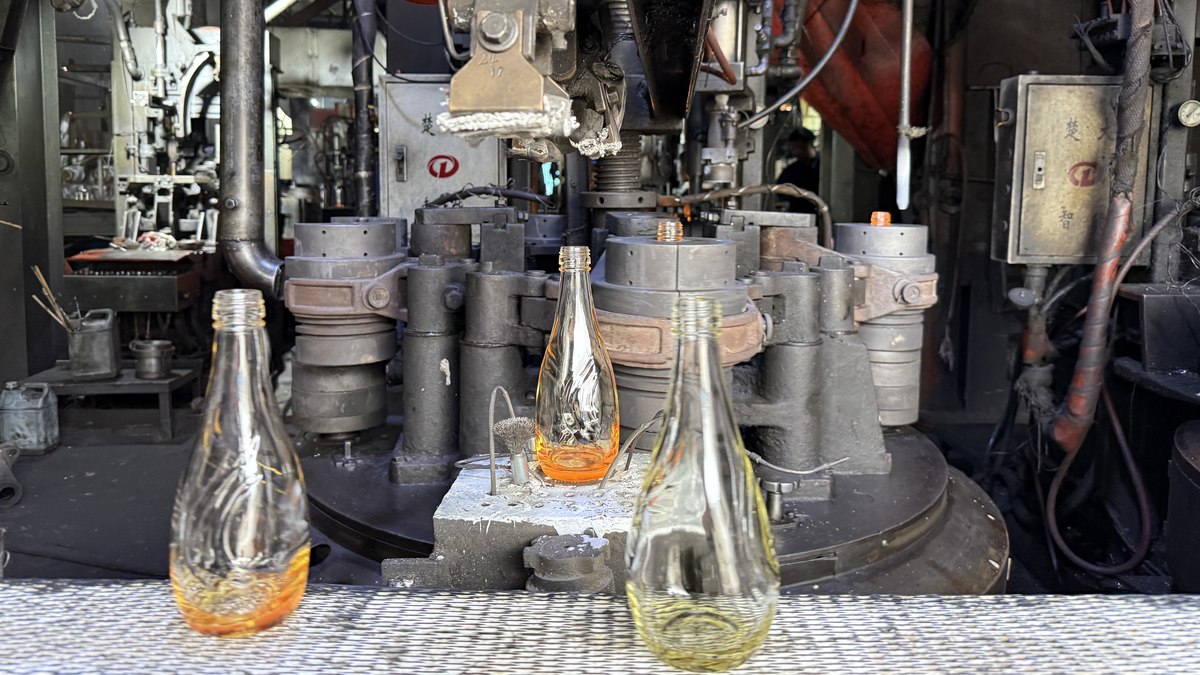
O-I’s Europe margin fell to 0.3% as it moves to close a French wine bottle plant, while Vetropack scales a bottle 30% lighter with 60% more use cycles.
In the same month, two European glassmakers published plans that point in opposite directions. O-I Glass opened the formal process to close its Vayres bottle plant in Gironde, France, after reporting a European operating margin of 0.3%. Vetropack moved its Rezon lightweight bottle out of pilot production and into industrial series output at Pöchlarn in Austria, at roughly twice the speed of the pilot line with the same workforce.
One is shrinking capacity to stop losing money on volume. The other is selling a bottle you cannot buy from a plant that just closed, because it is lighter, survives more trips and costs less to move. Both are responses to the same European market, and what they imply for buyers is not the same at all.
O-I moves to close Vayres
The first meeting of the job-protection plan (plan de sauvegarde de l'emploi) for the Vayres site in Gironde was held on 20 November 2026. The plant employs around 170 people and has produced very little since its last furnace was stopped in March 2026, so the closure process is formalising a shutdown that has effectively already happened.
Two details make the case unusually pointed. The CGT union says EUR 50 million had been invested in the site, which is a short life for that kind of capital in an industry where a furnace rebuild alone runs into tens of millions. And under France's Florange law, O-I must actively seek a buyer for the site before it can close it, so the plant may yet pass to another operator rather than disappear. Workers are planning to gather on 8 December.
The closure is not an isolated housekeeping move. With its third-quarter results, O-I said it had begun consultation with employee representatives on the proposed permanent closure of another European plant, carrying fourth-quarter charges of roughly USD 100–120 million, of which about USD 40–50 million is cash.
The number behind the decision
O-I's third-quarter release, filed on 27 October 2026, explains why capacity is coming out faster than demand is falling.
Group net sales were USD 1,623 million against USD 1,653 million, adjusted EBITDA fell to USD 234 million from USD 329 million, and the quarter produced a net loss of USD 13 million against net income of USD 30 million a year earlier. The segment split is where the story sits:
- Americas: USD 970 million of sales, USD 137 million operating profit, a 14.1% margin — broadly flat, and slightly helped by price.
- Europe: USD 634 million of sales, USD 2 million of operating profit, a 0.3% margin against 13.8% a year earlier.
The European decline is decomposed in the filing: net price cost USD 91 million, volume and mix another USD 4 million, and energy and freight came in about USD 15 million above management's expectation at the start of the quarter. European selling prices fell 3.8% and tonnage fell 3.7%.
Guidance followed. Full-year adjusted EBITDA was cut to about USD 925–950 million from USD 1,000–1,100 million, free cash flow is now expected to be a use of about USD 300 million rather than USD 50–150 million, year-end leverage is guided to 4.5–5.0 times against 3.5 times in 2025, and the company withdrew its 2027 targets entirely. The first nine months also carry an USD 873 million non-cash goodwill impairment taken against the European unit in the second quarter, which wrote European goodwill down to zero.
For anyone who buys glass in Europe, the operational fact matters more than the accounting: a supplier earning a 0.3% segment margin while removing capacity has no room to concede on price. The realistic planning assumption for 2027 is firm offers and tighter allocation, not relief.
Wine is the specific weak spot
Buried in the segment commentary is the line that connects this story to a specific product category. O-I attributed the European volume decline to weaker southern European shipments, particularly in wine, which offset improving demand in northern Europe.
That geography is not incidental. Southern Europe is where the wine bottle belt sits, and wine bottles are heavy, low-value-per-litre containers that are expensive to ship empty. When wine volumes soften — through lower harvests, falling domestic consumption, or brands switching to lighter formats and alternative packaging — the plants that make nothing but wine bottles lose their reason to run.
Vayres is a Bordeaux-area plant serving exactly that market. Its last furnace stopped in March; the closure meeting came in November. Buyers who source Bordeaux or generic claret bottles from south-west France should be checking now which plant their next order will actually run on, and whether the specification travels. Colour, neck finish and capacity are portable between plants; a decorative mould is not, and requalifying a bottle on a different machine takes time you may not have in the middle of a vintage cycle.
The wider signal is that European container glass capacity is being adjusted downward while policy simultaneously pushes demand toward reusable and higher-recycled-content formats. Those two forces do not cancel out. They concentrate production into fewer, better-utilised plants — which is precisely the environment in which lead times extend.
Vetropack went the other way
Against that backdrop, Vetropack's announcement reads as a deliberate alternative.
The group moved Rezon, its thermally strengthened lightweight bottle, from pilot phase into industrial series production. The new large-scale line at Pöchlarn has run since late summer at roughly twice the speed of the previous pilot plant with the same workforce, after training around 30 employees and producing more than 300,000 test bottles during ramp-up. Rezon is now made only at that plant.
The product dates from 2019, when Vetropack launched what it describes as the world's first thermally strengthened lightweight glass bottle. The claims are specific and, unusually, operational rather than aspirational:
- Up to 30% lighter than conventional reusable bottles
- Up to 60% more use cycles, because thermal strengthening raises resistance to scuffing
- Up to 33% more pallet capacity, from optimised bottle and crate geometry
- Up to 70% lower CO2 over the life cycle compared with single-use bottles
- Optional Data Matrix code for individual bottle identification and traceability
More than 35 million Rezon bottles are already on the market. In Austria, a 0.33-litre reusable bottle built on the technology has been available to brewers as a standard solution since early 2024, and brands including Gösser and Rieder have adopted it, which matters because Austria enforces a reusable quota. A second large-scale Rezon line is scheduled for Pöchlarn in 2027, with the intention of extending production to other group sites afterwards.
Why “lighter” and “more cycles” have to arrive together
Lightweighting is easy to sell and hard to do, because removing glass normally removes strength. A bottle that is 30% lighter but breaks earlier in the filling line, or fails after eight trips instead of twenty, is not a saving — it is a cost transferred to the customer.
That is why the 60% figure carries more weight than the 30%. Thermal strengthening is what allows the wall to be thinner without the bottle losing scuff resistance, and scuffing is the real killer in reuse loops: every trip through a washer and a conveyor abrades the surface, and surface damage becomes the crack that ends the bottle's life. Our guide to bottle weight and wall thickness covers the trade-off in more detail, and the transit breakage guide explains why lighter containers need their secondary packaging rethought rather than simply reused from the heavier specification.
The economics only close when weight and cycle count move together. A reusable bottle's cost per fill is purchase price plus washing and inspection, divided by trips. Lighter bottles cut the purchase price and the transport cost per trip; more trips cut the denominator. Vetropack quotes total cost of ownership rather than unit price for exactly this reason, and it is the right frame for a buyer comparing a reusable format against single-use.
It also explains the Data Matrix code. Reuse systems live or die on pool management — knowing how many bottles are in circulation, where they are, and how many trips each one has done. Individual bottle identification is what makes a deposit or pool scheme auditable instead of approximate.
The policy fight behind reuse
The same week, Poland supplied the other half of the picture: reuse is not only a technical question, it is a question of who is allowed to run the loop.
Poland's national deposit return system started on 1 October 2025, covering plastic bottles up to 3 litres, metal cans up to 1 litre and reusable glass bottles up to 1.5 litres. Joining the national scheme for reusable glass is voluntary until the end of 2028. Producers that keep running their own returnable glass systems must hit a 77% collection rate through 2028, rising to 90% from 2029, or pay a product fee — PLN 0.05 per kg in 2026, rising to PLN 0.25 per kg from 2027.
On 20 November, the country's bottling industry chamber asked the climate ministry to let producers keep their own systems running beyond 2028, alongside the national scheme. Its members report collection rates above 95%, and the chamber warns that forcing a switch would raise costs and push some producers toward single-use packaging instead.
The stakes are concrete for anyone selling into Poland. If dedicated brewery loops survive, reusable glass demand stays with the brewers' own bottle pools and their specifications. If volume is pushed into the national scheme, reuse becomes a commodity flow and single-use substitution becomes the cheaper escape route for smaller producers. Either outcome changes what a Polish customer orders, and in what volumes.
Read together with the cullet supply story and the EU carbon allowance deal, a pattern is forming across Europe: policy is raising the value of every container, while the manufacturing base that makes containers is contracting. Value up, capacity down is an uncomfortable combination for buyers.
What buyers should do now
- Confirm which plant your order runs on. Ask for the producing site in writing, and ask what happens to your specification if volume moves. A bottle qualified on one machine is not automatically qualified on another.
- Do not plan on 2027 price relief in Europe. A 0.3% segment margin and capacity withdrawals point the other way. Build the assumption of firm pricing and possible allocation into next year's budget rather than negotiating against last year's number.
- Qualify a second source before you need it. Closure processes take months and can end in a sale rather than a shutdown, but the uncertainty itself disrupts delivery schedules. Having a second qualified mould is cheap insurance.
- Evaluate reusable formats on cost per fill. Compare purchase price, washing and inspection cost, and trips per bottle — not unit price. Where a reuse loop is credible, lighter bottles with more cycles change the answer materially.
- Ask for the traceability option early. If a pool or deposit scheme is on your horizon, individual bottle coding is far easier to specify at the mould stage than to retrofit.
The split will not resolve quickly
O-I's chief executive has said Europe remains the company's biggest opportunity to create value, even as the company removes capacity from it. That is not a contradiction so much as a description of the strategy: fewer, fuller plants serving customers who will pay for reliability. Vetropack's route is different — keep the volume but change the product so that it earns a premium and supports a reuse loop that regulation is beginning to reward.
Both are rational. Neither produces cheap bottles. For brands and importers buying glass in or from Europe, the practical consequence is that the specification conversation now has to include supply security, plant location and reuse readiness, not just dimensions and price per thousand.
We supply wine bottles and spirits bottles in the formats and neck finishes most affected by this shift, and we can quote against a stated producing site rather than a generic catalogue line. If you are re-specifying for 2027, the price breakdown guide shows what actually moves a quote, and the AQL inspection guide covers how to protect quality when a supply base changes underneath you.
Need Glass Bottles for Your Project?
Contact us for free quotes and professional advice.
Get a Free Quote →