
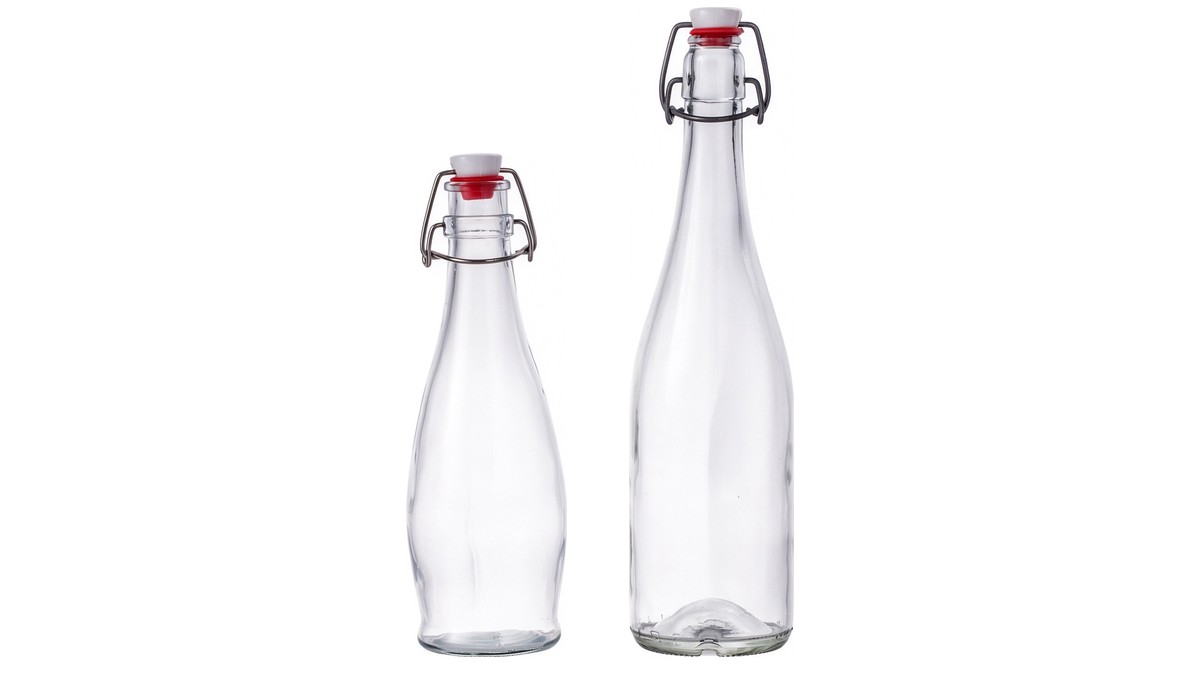
A 500ml sparkling water bottle can see 0.3-0.6 MPa at room temperature, yet must pass 1.2-1.6 MPa. Why still-water bottles fail, and what to specify.
A 500ml glass bottle of sparkling water looks almost identical to a 500ml bottle of still mineral water. Same glass, same transparency, same weight in the hand. Inside, one of them is a pressure vessel and the other is not, and the difference is the reason carbonated drinks have their own product standard, their own pressure test, and their own failure mode.
This guide covers what pressure actually builds inside a carbonated water bottle, which standards the bottle has to pass, why a still water mould cannot simply be reused for sparkling, and what to put in your purchase order so the bottle you receive matches the drink you intend to fill.
What Pressure Actually Builds Inside the Bottle
Carbonation is measured in volumes of CO2: the volume of gas dissolved in one volume of liquid at standard conditions. The numbers that matter for bottled water sit in a narrow band:
- Sparkling and soda water: 2.5–3.0 volumes
- Lemonade and cola-type drinks: 3.0–3.7 volumes
- Beer, for comparison: 2.2–2.7 volumes
China's national standard for carbonated drinks, GB/T 10792-2008, sets the floor at a gas content of 1.5 volumes measured at 20 °C. That is a minimum for compliance, not a target for a product that has to taste sharp. Most sparkling water brands run well above it.
During filling, the liquid is chilled to roughly 1–4 °C and carbonated against a head pressure in the region of 1.0–1.6 bar for a 2.5–3.0 volume product. Once the bottle is capped and returns to room temperature, the dissolved gas is held by the pressure in the headspace. A finished bottle of beer is commonly quoted at around 0.3 MPa of internal pressure at ambient conditions. Sparkling water, running at equal or higher carbonation, sits in the same order of magnitude — roughly 0.3–0.6 MPa depending on carbonation level and fill temperature.
That figure is worth holding onto, because it is the number that determines whether a bottle is over-engineered or dangerous.
The Two Standards That Decide Whether a Bottle Is Safe
Pressure resistance in glass is not a vague property. It is measured against a defined test, and the product standards set the pass mark.
GB 4544-2020 (beer bottles) requires a non-returnable bottle to withstand at least 1.0 MPa, and a returnable bottle at least 1.6 MPa. Within that, bottles are graded: 1.6 MPa for the top grade, 1.4 MPa for first grade, 1.2 MPa for the minimum acceptable grade.
Carbonated soft drink bottles are held to a comparable or stricter line — commonly 1.6 MPa for the higher grade and 1.2 MPa as the minimum.
The test itself is defined in GB/T 4546 and, internationally, ISO 7458:2004. Both describe the same two methods:
- Method A — constant pressure. The bottle is filled with water, pressurised at an initial rate of 1.0 MPa/s ±0.2, then held at the target pressure for 60 s ±2 s. The bottle passes if it does not break.
- Method B — constant rate. Pressure rises steadily at 0.58 MPa/s ±0.10 until the bottle bursts. The burst pressure is recorded, and a batch is evaluated on the average, the minimum and the spread.
A revised Chinese standard, GB/T 4546-2026, was published in July 2026 and unifies the rate for the constant-rate method at 0.58 MPa/s. If your supplier's test report is older than that, the numbers are still valid — but ask which method and which rate was used, because a constant-rate burst figure and a constant-pressure pass figure are not interchangeable.
Here is the practical consequence. A bottle rated at 1.2 MPa holding a drink at 0.4 MPa runs a safety factor of three. A still water bottle that was never designed for pressure has no defined factor at all — the number is simply unknown until someone tests it.
Why a Still Water Bottle Cannot Be Reused for Sparkling
This is the most common and most expensive mistake in the category. A buyer has a running still water programme, decides to add a sparkling SKU, and asks the existing supplier to fill the same bottle with carbonated water. The mould exists, the label fits, the pallet configuration is unchanged. Everything about the decision is convenient except the physics.
Still water bottles are designed around a different objective: minimum glass weight per unit volume, high clarity, fast forming speed, low cost. Wall thickness is distributed to survive filling, capping, transport and shelf stacking — vertical loads and impact, not hoop stress. The base is often a shallow dish. The shoulder is whatever shape the brand team approved.
Pressure loads a bottle differently. Internal pressure pushes outward against the whole body, with the highest stress concentrations at the shoulder curvature and the base knuckle. A profile optimised for weight and appearance has thin zones exactly where the stress concentrates.
Pushing a still water mould into carbonated service does not fail immediately. It fails as a rate: a small percentage of bottles bursting in the warehouse, in transit, or in a customer's hand. That is the worst kind of failure, because it arrives after the pallets have shipped.
Four Design Rules That Determine Pressure Resistance
1. Wall thickness distribution, not average thickness. A bottle with a 3.5mm average wall and a 1.8mm thin spot on one shoulder is a 1.8mm bottle. Pressure failure initiates at the thinnest point, and forming variation between cavities is where that point appears. Ask for the thickness distribution across cavities, not a single nominal figure. Our guide to glass bottle weight and thickness covers how to read those measurements.
2. Shoulder geometry. A generous radius spreads hoop stress; a tight radius or a sharp decorative edge concentrates it. This is why carbonated bottles have visibly rounder shoulders than still water bottles of the same capacity. If a design calls for a crisp shoulder line on a sparkling product, the wall thickness behind it has to increase to compensate.
3. Base design. The base is where most pressure failures start. A domed base — the punt you can see in the larger bottle in our cover image — converts a flat plate under pressure into an arch, which carries load in compression rather than bending. A shallow or flat base relies entirely on glass thickness to resist deflection.
4. Round beats square. A circular cross-section carries internal pressure as uniform hoop stress. A square or rectangular bottle has flat panels that deflect outward first, then load the corners, which are the least able part of the profile to take it. Square sparkling water bottles exist, but they need noticeably heavier glass than a round bottle of the same volume — and the weight goes straight into freight cost.
Closures: Where the Carbonation Actually Escapes
Glass does not lose gas. The closure does. A bottle can pass every pressure test and still be a commercial failure if it goes flat in three months, and that outcome is decided by the liner, not the glass.
Three closure families dominate sparkling water:
- Swing-top (mechanical clamp). The format shown in our cover image. A wire bail compresses a gasket against the bottle mouth; reopening and reclosing is possible many times. It suits premium and home-carbonation products, and the gasket material — EPDM or silicone — is the variable that decides gas retention.
- 28mm ROPP aluminium screw cap. Rolled onto the thread at capping, single-use. Consistent sealing, low cost, and the default for retail sparkling water in glass.
- Crown cap. The beer and soft drink standard. Highest reliability per unit cost, but not resealable.
Two specifications matter more than the closure style. The first is the mouth finish tolerance: an out-of-tolerance finish will leak regardless of how good the cap is, and this is covered in our neck finish guide. The second is the liner. CO2 permeates through some gasket materials faster than others, which is why the same bottle can hold carbonation for six months with one liner and three months with another. Compare the options in our closures comparison, and specify the liner explicitly rather than leaving it to the supplier's default.
Temperature Is the Variable Buyers Underestimate
Henry's law applies in both directions. Gas solubility falls as temperature rises, so warming a sealed bottle drives CO2 out of solution and into the headspace, and the headspace pressure rises. A bottle that was comfortable at 20 °C in the lab is not the same vessel at 50 °C in a delivery van in August.
Three operational rules follow, and none of them cost anything to implement:
- Specify storage at 5–25 °C on the label and in the trade terms. This is the range generally recommended for carbonated glass packaging, and it keeps the bottle well inside its design envelope.
- Keep pallets off the top layer of a warehouse and out of direct sun. Roof spaces in summer routinely exceed ambient by a wide margin.
- Never freeze a glass bottle to chill it quickly. Rapid cooling makes glass more brittle, and the thermal shock adds stress on top of the internal pressure.
Transport handling deserves the same attention. Impact damage creates micro-cracks that reduce pressure resistance without any visible break, and those bottles fail later under normal pressure. Our article on why glass bottles break in transit covers the packaging and pallet measures that prevent it.
What to Ask Your Supplier Before Ordering
Pressure resistance is one of the few properties where a supplier cannot bluff, because the evidence is a test report with a method and a number on it. Ask for the following before the mould is opened:
- A pressure test report to GB/T 4546 or ISO 7458, stating which method (constant pressure or constant rate), the pressure reached, and the sample size.
- An explicit rating: 1.2 MPa or 1.6 MPa. Do not accept "pressure resistant" or "suitable for carbonated drinks" as an answer. The number is the specification.
- Wall thickness distribution across cavities, including the minimum, not just the nominal.
- Mouth finish dimensions and tolerances, matched to the closure you have chosen.
- Liner material and its gas permeation behaviour, with a shelf-life claim you can test.
- An AQL sampling plan for the incoming inspection, covering pressure, thickness and finish. Our AQL inspection guide sets out how to build one.
Capacity tolerance belongs on the same list. A sparkling water line filling to a declared volume needs the bottle's actual capacity to sit inside a known band, or every fill head drifts. The figures are set out in our capacity tolerance guide.
The Short Version
If the product is carbonated, the bottle is a pressure vessel and has to be specified as one: a dedicated mould with a domed base and a rounded shoulder, wall thickness verified by cavity rather than by average, a pressure rating of 1.2 MPa minimum and 1.6 MPa for anything at the higher end of the carbonation range, and a closure whose liner is chosen for gas retention rather than availability.
The still water bottles in our water bottle range — including the 500ml mineral water bottle, the 750ml bottle and the 330ml to 1 litre series — are built for still applications. If you are developing a sparkling SKU, tell us the carbonation level and target shelf life at the enquiry stage and we will quote a pressure-rated profile instead of adapting a still one.
Need Glass Bottles for Your Project?
Contact us for free quotes and professional advice.
Get a Free Quote →